These Non-Traditional Methods Changed My Life as a Guitarist
There are a few events that happened in my early years of playing guitar that really shaped my guitar playing and the way I hear and write music. Funny thing is, I didn’t realize this until years later. Because some of them are not typical, especially for someone who is primarily a metal guitarist.
I’m sharing these with you because even if you implement just one of these things, I think it could help you expand and grow into a version of yourself you never imagined, regardless of what style or genre you play.
The Backstory (the short version)
We’re going to go back a few decades here. Back to the time when the phrase ‘be kind, rewind’ was often heard when you’re trying to find the new release of Nightmare on Elm Street.
There was this dude at school who had long hair, wore a jean jacket covered in patches, and always air-drumming with his headphones on, happy, in his own world. I heavily (no pun intended) admired this guy. I think his name was Kevin (if I recall, we went to Ransom Middle School and Tate High School together).
As timid as I was back then, I built up the courage to ask him, “Hey man, what are you listening to?”
He pulled away one of his headphones and said, “Metallica!” and went back to air-drumming. He knew he had sold me on heavy metal.
So that week, I took $20 I had from mowing people’s grass and bought the two cassettes, ‘Master of Puppets’ and ‘And Justice for All.’
It wasn’t long after that when I picked up my Uncle’s old acoustic that had four rusty strings. I just started messing around with it. I ultimately picked out the single notes of Sabbath’s Iron Man. My uncle saw that I was serious and picked me up some new strings and a Mel Bay chord book.
I dove in headfirst. A month or so later, my parents teamed up with a local musician that my dad grew up with, and we got my first electric guitar. After hearing Metallica and discovering other guitar-driven music, I didn’t want to just listen to it. I needed to be a part of it.
If you want the full version of this story, I’ve got it in my book Heavy Metal and Weights.
Playing in Different Keys, and Sometimes Different Styles
I grew up going to a small church in Cantonment, FL. I think it was a Pentecostal Holiness church. No, we didn’t handle snakes or anything like that.
We had a small music group, and there was a guitarist named Ronnie Goodman. He was more of a jazz/blues player. Not my style at all. But I was always amazed by his playing. He would play the chords to the songs, which were mainly really old gospel hymns. But then he would break out and play solos. And I could tell he was just making up the notes and melodies. That was my intro to improvising.
So my friend and I, Alex Green, ended up playing in the church band. Alex was about a year ahead of me as a guitarist. And we were both into all kinds of metal and rock n’ roll. But more than anything, we just wanted to play our guitars.
As you would imagine, these old hymns were not what we were used to playing. And pretty much every song was played in what I call piano-friendly keys (not guitar-friendly) like A♭, B♭, E♭.
Ronnie insisted that we learn the chords to the songs, which we were using bar chords. Then he would point to us when it was time for a solo. That’s when we had to make up something. Alex and I would switch off and on with our leads.
There were no tabs, and neither of us could read music. We just had to memorize the chords and make up our own solos.
Now, it should be obvious that when I was home, I was learning songs by Metallica, Guns N’ Roses, Whitesnake, and Scorpions, along with some hair metal bands.
So it was metal at home, and gospel hymns in weird keys on church days.
What did this do for me? It forced me to learn the fretboard in a way I never would have learned it otherwise. It also broadened the way I hear music and the way I write my own music. And I can sit in with just about any band and play along. That’s a really cool skill to have.
I’m not suggesting that you grab a book of hymns and learn gospel music. And I’m not suggesting that you play stuff you don’t really like. But you will be surprised how playing music in different keys, and in some cases different styles, can help you grow tremendously as a musician, and even make you better at playing the style you do like.
Improvising Along with the Radio
There were two radio stations in the area of Pensacola, FL that played rock: TK-101 and WABB FM-97. There were a couple of others, but I don’t recall the names.
TK-101 played the harder stuff like Whitesnake, Def Leppard, Dokken, and GnR, etc. WABB FM-97 would dip into that sometimes, but mainly played pop-rock, stuff like Genesis, Madonna, Prince, Richard Marx, The Outfield, and those types of bands.
As much as I loved metal, I also loved 80s rock, in general. And even most of the pop stuff, too. But here’s where the magic happened for me, and I didn’t even realize how this impacted me until years later.
I would listen to the radio for hours while having my guitar plugged into my amplifier, and just make up solos along with every song. I would try to get the chord progression down first. Not necessarily learning the riffs or the solos note-for-note. But I’d hear the underlying chord progression and just play power chords to that, followed by improvising solos.
The thing is, almost every song was a different key, sometimes a different style, and often a completely different feel.
You can see how that fits what I was doing in church. Learn the gist of it, then improvise. Of course, jamming along with the radio, those old yet huge speakers cranked up with my amp, I was playing along with the music I love, and that passion was growing by the day.
You can do this, too. These days, we have streaming and the ability to start your own radio station based on a song. Chances are, you have several stations and playlists of different styles and genres.
Press play, then plug in your guitar and just let yourself go. Get the basic progression down, and then start making up some licks that fit that key. The more you do this, you will be amazed by what you come up with.
Jamming With Other Musicians
As you’ve learned, I was jamming with other musicians the moment I started playing guitar. Well, maybe a month or so after.
I mentioned my friend Alex, who had been playing for about a year before I started. The guy is still a phenomenal guitarist. I remember him showing me and Ronnie this tapping technique with his pick that he had figured out. It was crazy. And it was cool.
We’d jam constantly, at his house, at my house, anywhere and everywhere. One time, we set up our amps on my porch, cranked them super loud (we really didn’t know any better back then), and someone called the cops.
Of course, we were also playing together in church with Ronnie. Ronnie (rest in peace) was not only an insanely talented blues/jazz guitarist, but he was also encouraging in a way that stuck with me forever. He always pushed us to play our way. So when you hear me say like a broken record to “Focus on developing your own style,” that’s where it came from.
If Ronnie was strumming on his acoustic, I couldn’t just play the same thing. I had to create something that complemented that (I was always playing my electric). There was also the piano, which was the culprit of most songs. Alex and I also learned to play bass, as that was a missing part (3 guitarists with no bass isn’t ideal).
Soon after Alex and I were playing, some of our friends picked up instruments (Matt Gainey was on bass, Matt Patrick on keys), and we formed a little group called Revelation. We never wrote anything but just jammed, and we also played some of the songs Ronnie had written.
Why does this matter? I learned not to just play notes. I learned to feel what I was playing, and most importantly, to listen. Guitarists are notorious for wanting to be the center of attention and be heard over everything else. But I realized early on that really honing in on all of the other instruments, that everything had its time and place, and everything needed to flow together to make something sound really amazing.
One Thing Leads to Another. It’s Part of the Journey
Let’s fast-forward a little to when I graduated high school (barely) in 1993. That summer, I got introduced to this dude Eddie Gray, who has remained one of my closest friends to this day. He managed a band called Palin Genesia, which means ‘A New Beginning’ in Greek, or something like that. They needed a lead guitarist.
We were sort of an alternative rock band with the caveat of having 80s-style solos (blame me for that). This was a strange time in music because grunge was in full swing, and guitar solos were swept under the rug for a brief time. But we were booking shows. That was a really cool experience.
As many band stories go, after about two years, everything fell apart. People wanted to go in different directions, or lost passion for the band, or whatever the case was. The band was no more.
After being on stages in front of hundreds (these were smaller shows), I was hooked and could not stomach the idea of not playing live. So, Eddie and I formed our own band, and we called ourselves ‘The Guys.’ We wrote originals and threw in a few covers to make a full set.
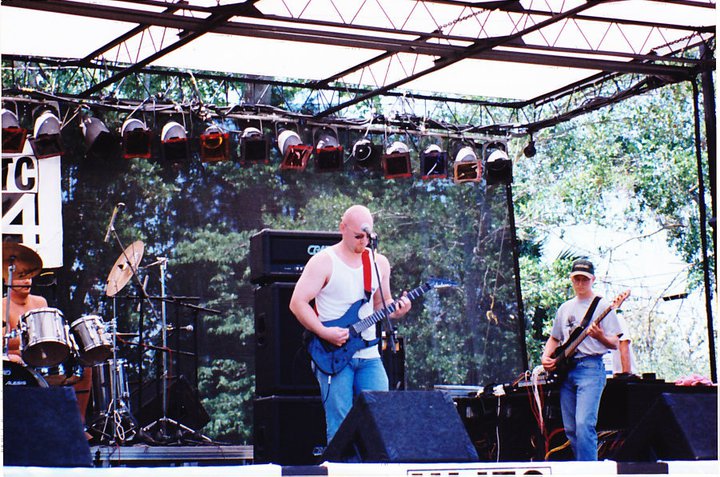
After a couple of shows, we even landed a slot at Springfest in 1999, a huge deal for us. Eddie Money performed on the stage next to ours that day, which I thought was cool.
For that Springfest show, we brought in another guitarist, Tom Sherman, who also remains one of my closest friends. For some reason, he wasn’t captured in the pic below. Not sure who was on camera duty that day (this was before the world of cell phones capturing every moment).
The Guys was also short-lived. I ended up moving to Tampa (this was around 2000), but from there on, I’ve always played live music in some capacity, whether with bands or playing solo acoustic shows. And I always will.
Playing in Front People Will Make You Better, by Default
You get it. Playing with musicians can really help you expand your guitar skills and become a better overall musician. You learn how to fit in the pocket, how to listen to the music overall, and really hear everything that’s going on, dynamics, when to be heard, and when to pull back. I could keep going.
But there’s another important element that goes right along with that, and it’s simply playing in front of people. You want to talk about developing a strong sense of playing guitar on top of a completely different skill? Performing in front of a crowd, big or small, will do just that.
Look, it’s easy to sit in your room and jam. It’s comfortable. Nobody’s watching, nobody’s judging, you can stop and start again, fix mistakes, and there’s no pressure.
If you’ve never played in front of a crowd, here’s what I urge you to do. Learn 2-3 songs (or write your own), and go to an open mic. Even if you don’t sing, just bring your guitar and play for a few minutes. Heck, it may even just be a short guitar solo that you wrote.
I can almost promise you that you will become addicted to playing in front of people, and you will become a regular at your local open mic. So, yeah, do a quick search for open mics in your area and show up (with your guitar).
Pause (this is the pause while you search for open mics, because I’m serious about your doing this).
What’s Next for You?
When I look back over my own journey, these experiences shaped me more than I ever realized at the time. And I genuinely believe they can make a massive impact on your guitar playing, too.
Sure, some of this stuff isn’t traditional guitar learning where you’re told you have to study theory like it’s homework for a major exam, and learn the song perfectly, note for note, or you get a smack on the wrist.
Through the road I traveled, it was more about expression and creating. I’m not an anti-theory guy by the way (I later realized I had inadvertently learned a decent bit of music theory, mainly simply by playing in all those non-guitar-friendly piano keys!).
In the end, it’s not about replicating what someone else can do or has done. It’s about what you have to say through your music. It’s about developing your own style.
So, a few takeaways for you:
1. Stretch yourself by playing in different keys (and even different styles).
This is one of the fastest ways to learn the fretboard, understand music at a deeper level, and become more fluid and confident when you improvise. When you step outside the one or two keys you always play in, you open new pathways in your head and fingers, and I’ll even say from deep within. And this, in a weird way, actually makes you better at your preferred genre and style. Don’t fight me on this. Trust me and just do. it.
2. Jam with other musicians every chance you get.
Even if it’s just another buddy who plays guitar. Or if you can jam with a group. Or search online for people in your area to play music with. Even better, make friends at open mics and start jamming together there. So many things open up when you get out of your bedroom (and get out of your own head) and play music with other musicians.
3. Play in front of people. Your cat doesn’t count.
I’ll revert to open mic if you’re new to this and haven’t played in front of anyone. Or you could play at gatherings (friends, family, cookouts, movie night…just don’t play during the movie unless the movie sucks). When you become comfortable playing in front of people, it builds this hidden, secretive skill that you never knew you had.
Thanks for spending these few minutes with me. It was like having a nice chat over a beer or coffee. I do hope you got some encouragement out of this and are ready to take this next step in your journey.
On that note, no pun intended, I do have a guitar academy. Check it out. See if it’s for you.
Keep it Metal, and Keep Playing Music,
Jason