3 Things That Changed My Life as a Guitarist (and How They Can Change Yours)
There are three events that happened early on that I feel like changed everything for me as a guitarist and musician. I didn’t realize it back then, but looking back now, these moments shaped the way I play, the way I hear music, and the way I grew over the years.
And I want to share them with you, not just as stories, but as real concepts you can start using immediately. Even if you take just one of these ideas and apply it this week, it can transform how you approach this instrument we both love.
Here’s a quick snapshot of the three concepts we’re about to dig into:
- Play in different keys (and sometimes different styles): this strengthens your fretboard knowledge and makes improvising feel natural.
- Jam with other musicians: this pulls you out of “bedroom playing mode” and helps you learn how to fit in the pocket, collaborate, and build musical chemistry.
- Play in front of people whenever you can: this builds confidence, awareness, timing, and turns you into a more expressive and fearless guitarist.
Below, I’ll walk you through how each one shaped me, and how you can start using these same concepts in your own guitar journey.
Watch the Full Video
If you want to hear the full stories and how each of these moments unfolded (plus how you can apply them), definitely watch the YouTube video I made to go along with this post:
1. Playing in Different Keys (and Sometimes Different Styles)
This is what quietly built my fretboard knowledge, my ear, and my confidence as an improviser.
Let’s back up for a minute, way back to the end of 1990.
(Side note… I’ve been saying 1989 for years, so I’ve been lying to all of you unintentionally! I finally did the math and realized: nope, end of 1990. So as of now, I’ve been playing guitar for about 35 years.)
Like many of us, I started out on a beat-up acoustic with four rusty strings that belonged to my uncle. I’ll spare you the whole backstory; it’s in my book Heavy Metal & Weights if you want the deeper version, but the short version is this:
What really lit the spark was a kid on my school bus.
Long hair, jean jacket covered in patches, headphones on, always air-drumming, always happy. I thought he was the coolest dude alive. I was timid and honestly scared to talk to him… but one day I asked:
“Hey man… what are you listening to?”
He slid one headphone off and said:
“Metallica.”
Then he put it back on and went right back to air-drumming.
That was it. I was sold. Immediately hooked.
(If your name is Kevin Larone and you somehow see this, dude, thank you. You helped set my whole life in motion.)
Soon after that, my parents saw I was serious, got me my first electric guitar, and I dove headfirst into metal: Master of Puppets, …And Justice for All, then Guns N’ Roses, Whitesnake, Scorpions, Winger, all the hair bands, everything.
But here’s where the unexpected thing happened.
👉 Read the entire story and more in my book:
Heavy Metal and Weights: My Story of Guitar, Weights, Heavy Metal Workout Albums, Passion, and Building Muscle Kindle Edition
Metal at home… and gospel hymns in church?
I grew up in a small country church. And in that church was a guitarist named Ronnie Goodman, who was more of a jazz/blues player. Not my style at all. But I was mesmerized by this guy. He could make up melodies on the spot, and every single thing he played sounded beautiful and polished.
Nothing was rehearsed. Nothing was memorized.
He was just playing.
And the songs we played in church?
They were all piano-friendly keys: A♭, B♭, E♭– the kind of keys most guitarists avoid like the plague.
But Ronnie insisted:
“Learn the chords…then it’s time for your solo.”
No tabs. No notation. Just your ears and the fretboard.
Playing in those weird keys forced me to learn bar chords early, and it pushed me to understand the fretboard in a way I never would’ve if I’d stayed in E minor chug-chug land.
At the same time, I was jamming outside of church with my best friend Alex Green, who could shred, and we were learning Tesla intros, metal riffs, faster leads, all the cool stuff we loved.
So picture this combo:
- Metal at home
- Gospel hymns in A♭ and B♭ at church
- Bar chords and improvising on the fly
- Playing with other young musicians in multiple keys
That mix unknowingly laid the foundation for everything I do today.
The second ingredient: playing along with the radio
This one might be the biggest sleeper hack for guitar players.
Back then, I’d plug into my amp, turn on the radio (TK-101, WABB FM-97… if you’re from Pensacola, you know), and play along with whatever song came on:
- Prince
- Def Leppard
- Madonna
- Genesis
- Ratt
- Dokken
- Anything and everything
Every song was a different key, different tuning, and different feel.
I’d quickly figure out the chord movement, not perfectly, just the basic structure, and then start improvising my own leads over it, the same way Ronnie had taught us.
That right there made me the guitarist I am today.
Not learning songs note-for-note.
Not memorizing scales.
Not playing the same riffs over and over.
But exploring keys, adapting on the fly, and trusting my ears.
Why this matters for YOU
If you always stay inside the same shapes, the same keys, and the same style, you will plateau without realizing it.
But when you:
- play in different keys (especially “weird” ones)
- force yourself into new musical environments
- improvise over chord progressions you didn’t plan
- try styles you normally wouldn’t touch
Your fretboard opens up. Your ear gets sharper. Your improvisation gets smoother. Your confidence skyrockets.
You become a musician, not just a guitarist.
And ironically?
This makes you dramatically better at playing metal, the style you love.
Because now you can fit into any pocket, adapt instantly, and express yourself without overthinking.
2. Jamming With Other Musicians (Why This Will Explode Your Growth)
The second concept I want to share stays in the early-’90s timeline for a bit… but then it stretches way beyond that. And honestly, this one might be one of the most powerful things you can do as a guitarist.
As soon as I started playing, I was jamming with other musicians. Immediately.
My friend Alex, the same Alex from Section 1, had been playing for about a year before I picked up a guitar, so naturally, he was ahead of me. The guy is still a phenomenal guitarist. I remember him showing me this tapping technique he did with his pick, and my mind was blown. Like, “Dude, how are you even doing that?”
We’d jam constantly, at his house, at my house, anywhere. One time, we set up our amps on my parents’ porch, cranked them, and someone called the cops. And listen… this was out in the country. So, for someone to hear us from that far away? Yeah, we had those amps roaring.
Of course, we were also playing together in church with Ronnie Goodman. Ronnie (rest in peace) was not only an insanely talented blues/jazz guitarist, but he was also encouraging in a way that stuck with me forever. He always pushed us to play our way, to develop our own style, and that message is something I repeat to my students constantly. Ronnie’s sister, Rhetta, played the piano, and she was the reason we were always playing in those “odd” keys, like A♭ and B♭.
And here’s why this mattered:
Playing with other musicians forces you to listen.
If Ronnie was strumming one thing, I couldn’t just copy him. I had to find a different part that complemented what he was doing. If Retta’s piano part was busy or bright, I needed to fill a different space on electric guitar. I wasn’t leading, I was following, and that taught me an invaluable skill:
Playing in the pocket.
I had to figure out:
- What rhythms fit with the other instruments
- What strumming patterns supported the overall sound
- What small licks or fills added flavor without stepping on anyone else
Even when Alex and I were jamming metal, we would constantly branch off. We’d start off playing a song we knew, but then one of us would improvise a riff or a lead that wasn’t part of the original. That’s where the fun was. That’s where creativity started bubbling up.
And you hear me say this all the time:
👉 Learn the stuff I teach you, then branch off and create your own version of it.
That’s where your unique sound lives.
Not in copying note-for-note.
Not in doing things “the right way.”
But in exploring, stretching, and creating.
Because that’s what you’re meant to do.
My first bands (and how playing with others shaped me even further)
Fast-forward a bit: I graduated high school in 1993 and got connected with a guy named Eddie Gray, one of my closest friends to this day. He managed a band called Pelan Genesia (“a new beginning” in Greek). Through our mutual friend Mike Tipton, Eddie heard about me, and before I knew it, I was the lead guitarist in the band.
Now I wasn’t just jamming in church or improvising with one friend…
I was in a full, functioning alternative rock/metal band.
We built a solid following in the Pensacola area. We were tight, we were writing, and we were playing live. That experience alone changed everything: learning to rehearse regularly, navigating personalities, and figuring out who plays what and where.
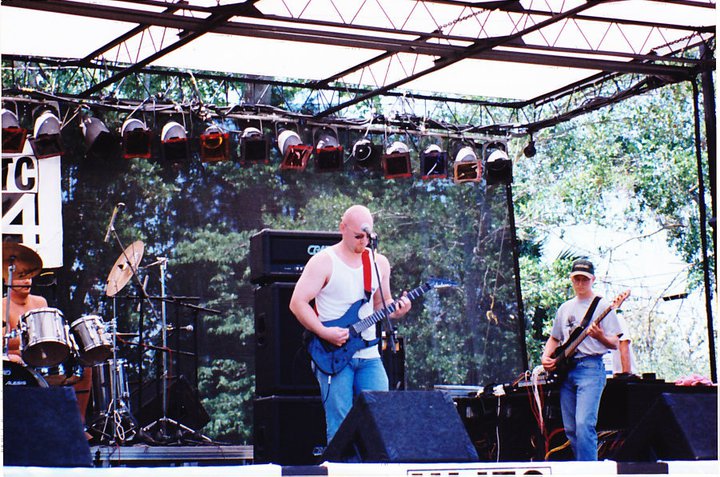
The band eventually split (as many do), but Eddie and I stayed great friends and decided to form our own project: The Guys. We brought in a drummer, started playing festivals, and really began carving our own sound. We even landed a slot at Springfest in 1999, a huge deal for us. Eddie Money performed on the stage next to ours that day, which still blows my mind.
For that Springfest show, I wanted a second guitarist, because jamming with others had taught me how important it is to have multiple musical voices. That’s when I brought in Tom Sherman, still a close friend to this day, and the sound finally felt complete.
Why this matters for YOU
You can only get so far by playing alone. Yes, practice by yourself. Yes, woodshed. But the moment you add another human being into the mix, everything changes:
- You start hearing music differently.
- You learn how your part fits into a bigger picture.
- You begin complementing instead of competing.
- Your timing tightens.
- Your creativity skyrockets.
And here’s the big one:
👉 You stop being “just someone who plays guitar”… and you start becoming a musician.
I encourage you, no matter where you’re at, to jam with other musicians whenever you can:
- A friend who also plays guitar
- A bass player
- A drummer
- A full band
- Someone with a completely different style
Because of the synergy, the push-pull, the ideas that happen in those moments…
That’s where magic is created.
And who knows, you might end up writing some of your best music with someone you haven’t even met yet.
3. Playing in Front of People (The Skill You Don’t Realize You Need Yet)
This last concept might not seem important right now, especially if you’re not trying to start a band, play shows, or become a performer. Maybe guitar is just a hobby for you. And that’s perfectly okay.
But hear me out:
👉 Playing in front of people, at any level, builds a completely different skill set that can transform your musicianship.
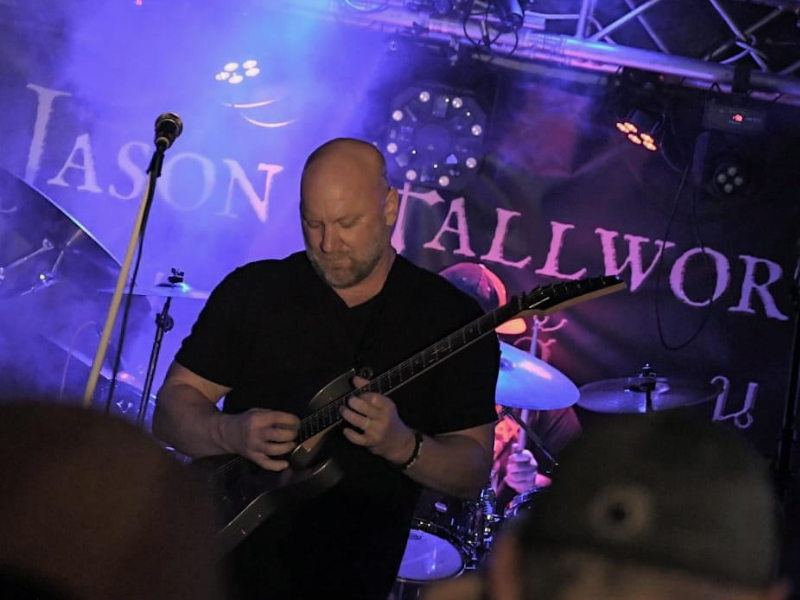
I’ve been playing in front of people almost since the moment I picked up the guitar. It started in church, then in bands, then at festivals, and now through my solo shows. For nearly 35 years, playing live has been a part of who I am as a guitarist.
And even if you never plan on stepping on a big stage or touring…
There’s still a version of this that you absolutely should be doing.
Why Playing in Front of People Changes Everything
Look, it’s easy to sit in your room and jam. It’s comfortable. Nobody’s watching, nobody’s judging, you can stop and start again, fix mistakes, retake the riff, turn the camera off, whatever.
But the second you get in front of even a handful of people, things shift.
- Your timing sharpens
- Your focus increases
- Your nerves kick in (in a good way)
- You learn to recover gracefully
- You start hearing your playing differently
- Your confidence grows
- And your musicianship levels up faster than you ever expected
Honestly, sometimes playing in front of five people is scarier than playing in front of fifty. It’s intimate. Every detail matters. But that’s exactly why it’s so powerful.
And here’s the thing:
Most people at open mics or small gatherings want you to succeed. They’re encouraging. They’re supportive. They’re musicians too, or at least music lovers, so the energy is positive. If you miss a note, they don’t care. You’re there to grow.
Open Mics: Your Secret Weapon (Even If You Don’t Want to Perform)
If you’re not in a band and don’t plan to be, the easiest way to build this skill is:
👉 Go to an open mic.
Every city, every town, someone’s hosting one. And if not? Maybe that’s the universe nudging you to create one.
When I used to host open mics at Bootleggers Brewing (before they relocated), the vibe was amazing. People of all skill levels, all ages, all styles. Everyone is there to lift each other up and share music. If you showed up nervous, you left empowered.
Even if you only get up there for a two-minute jam, just a simple chord progression or a riff you like, you’re doing something incredibly important:
You’re putting yourself in the arena.
And that experience pays off the moment you go back home and plug into your amp. Your skill level jumps. Your awareness improves. You feel different when you play.
Playing in Front of People Doesn’t Have to Mean “Being in a Band”
You can:
- Jam for friends at a gathering
- Play for your family
- Loop a rhythm at home and pretend you’re on stage
- Join someone else’s rehearsal
- Sit in during a band practice
- Bring your electric to an open mic
- Play acoustic covers at small venues
- Jam with one other musician in the same room
All of this counts.
Right now, my own live playing is a mix of both worlds:
- A couple of shows per year, performing metal from my albums with band members I bring together
- And several solo acoustic gigs each month across Tampa, dockside venues, wineries, breweries, and private events
Do I play metal at those acoustic shows?
Not usually. I play 80s songs. I loop rhythms. I improvise solos. But it keeps me sharp, creative, and connected.
Playing in front of people, even if it’s not “your” genre, pushes you into new territory.
It challenges you.
It humbles you.
It strengthens your timing and confidence.
It sharpens your improvisation.
And it helps you grow not just as a guitarist, but as a musician and as a person.
Why This Matters for YOU
If you take nothing else from this section, take this:
👉 When you play in front of people, everything about your musicianship accelerates.
Your confidence.
Your timing.
Your ear.
Your creativity.
Your composure.
Your ability to respond in the moment.
Even if your dream is simply to play amazing riffs in your studio for your own enjoyment, playing for someone, anyone, will elevate everything you do when you’re back home practicing.
It brings everything full circle.
Wrapping It All Up
When I look back over my own journey, these three things shaped me more than I ever realized at the time. And I genuinely believe they can make a massive impact on your guitar playing, too.
1. Stretch yourself by playing in different keys (and even different styles).
This is one of the fastest ways to learn the fretboard, understand music on a deeper level, and become more fluid and confident when you improvise. When you step outside the one or two keys you always play in, you unlock parts of your musicianship you didn’t even know were there.
2. Jam with other musicians whenever you get the chance.
There’s nothing quite like that exchange of ideas, your creativity mixing with theirs. Whether it’s a buddy on guitar, a bass player who brings a whole new feel, or a drummer who pushes your timing into a new pocket… playing with other humans creates something organic and alive. It grows you in a way that practicing alone simply can’t.
3. Play in front of people in any capacity you can.
This doesn’t have to mean joining a band or booking big shows. You can play for family, for friends, at small gatherings, or at open mics. Playing live, even on the smallest scale, builds confidence, strengthens your timing, sharpens your awareness, and accelerates your growth as a musician. Something shifts inside you when your playing leaves the bedroom and enters the real world.
These three concepts aren’t complicated, but they’re powerful. They’re practical. And you can start implementing them right away. If you do, you’ll not only become a better guitarist, but you’ll also become a more expressive, confident, and creative musician overall.
Want to Take Your Metal Playing Even Further?
If you’re ready to build deeper skills, learn new riffs and licks, and grow as a metal guitarist in a clear, structured way, the Jason Stallworth Guitar Academy is where I can help you the most.
Inside, you’ll find:
- step-by-step metal courses
- riffs and licks that build real-world skills
- improvisation frameworks
- backing tracks
- tabs, Guitar Pro files, and clear video lessons
- and an approach that helps you develop your own voice as a guitarist
If you’re serious about leveling up your metal playing, whether you’re brand new or you’ve been at it a while, I’d love to help you get there.
👉 Learn more about the Academy here
Thanks for spending this time with me. This whole topic feels like a personal fireside chat, just two people who love the instrument, talking about the things that actually matter in becoming a better musician.
As always…
Keep it metal, and keep playing music. 🎸🔥
Jason