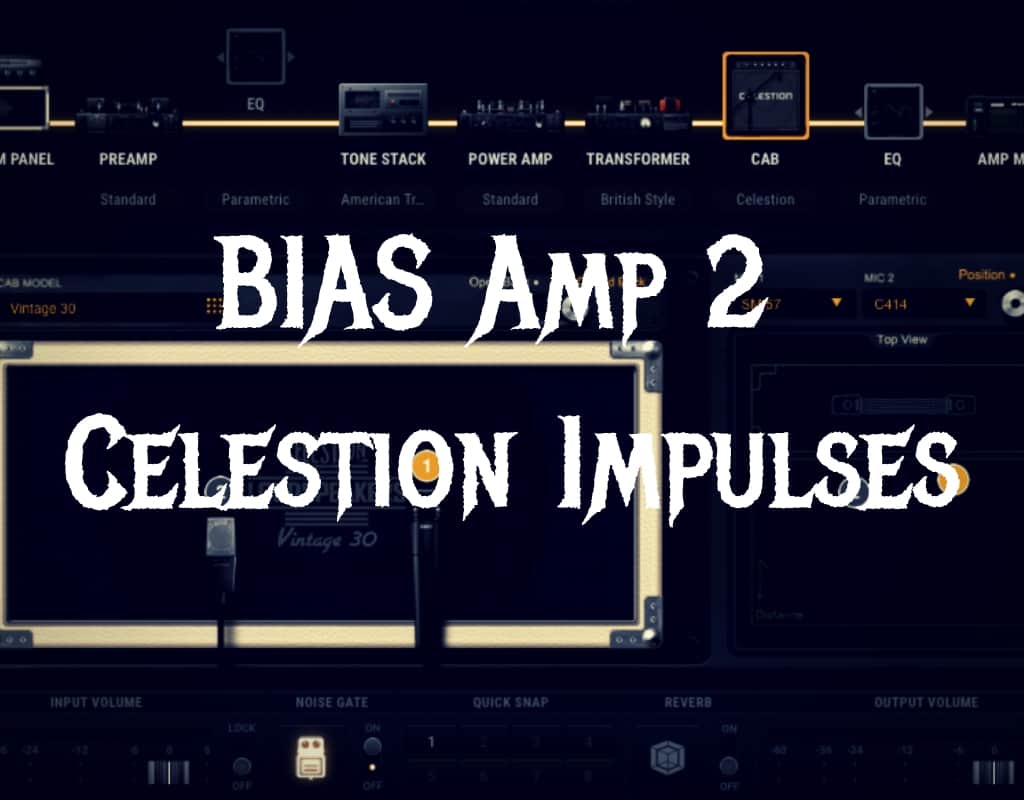
Metal Tones with BIAS Amp 2 Celestion Speakers (Cab/Speaker Impulses)
There’s one area guitar amp sims and plugins have fallen short: cabinets and speakers. Most of them suck!
I had been seeing ads for Positive Grid BIAS Amp 2. I also saw that they had a special package with Celestion Classic impulse responses. After spending a little time with the demo, I made the jump and upgraded.
Let me just say that the Celestion speaker impulses with BIAS Amp 2 changed the entire realm of virtual guitar tones!
In this post, I’m going to demonstrate the Celestion Classic Pack that comes with the BIAS Amp 2 Elite suite (hey, that kinda rhymes…sweet!). I’ll also give you some more Celestion tones using different amps.
BIAS Amp 2 Celestion Metal Tone Comparison
In the below video, you’ll hear a demo of all 5 BIAS Amp 2 Celestion Classic speaker impulses available.
To add, the BIAS Amp 2 plugin gives you the option of using the cabinet sizes:
- 1×12
- 2×12
- 4×12
As you would expect, I went straight for the 4×12 cab on all of the the clips you’ll hear!
Celestion Metal Impulse Shootout
Now I’d like to go through a quick rundown of each BIAS Amp 2 Celestion speaker I used. These are in the order you heard in the video above…
1 – Celestion Blue

The Celestion Blue is the first speaker used in the mix. I really like how this sounds for metal, although it’s not typically a heavy metal speaker. But it seems to really bring out the notes for metal.
Also, it’s sometimes a good idea to use a speaker that may not be designed for your particular style of music to get a different sound. I think we’re all a bit tired of new bands coming out sounding like every other band!
2 – Celestion G12-65

The G12-65 is probably my least favorite BIAS Amp 2 Celestion speaker for metal. I can’t pinpoint it exactly, but there seems to be a weird frequency I’m hearing.
On that note, I used the G12-65 with the BIAS Amp 2 67 Blackface amp, and wow! Beautiful tone.
3 – Celestion G12H Anniversary

The Celestion G12H Anniversary sounded cool but wasn’t my favorite speaker for metal. But I did test this on some clean and lighter rock tones, and it sounded spot on!
Also, I could totally see recording one metal track with this and using a different Celestion speaker (like the Blue or Vintage 30). I think the blend would sound cool. Remember what I said above about creating a new sound!
4 – Celestion G12M Greenback

The G12M Greenback is just a beast for metal! In fact, many metal guitarists have been known to use the physical Celestion Greenback speakers for their saturated tones.
This is one of my favorite Celestion impulses because it gives your metal rhythms a tight and pronounced tone.
5 – Celestion Vintage 30

The Celestion Vintage 30 speaker probably the best-known speaker throughout both the rock and metal community. And the Celestion Vintage 30 impulse with BIAS Amp 2 has been my go-to for my metal tones.
The best tone I’ve gotten is mixing the Celestion Vintage 30 with the G12M Greenback impulses. Here’s what my personal BIAS Amp 2 tracks look like:
- Rhythm Guitar 1 – Panned Left – Vintage 30
- Rhythm Guitar 1 – Panned Right – G12M Greenback
**For my lead tracks, I use the Vintage 30 as this impulse really cuts through the mix.
**You can read more about Celestion teaming up with Positive Grid here (and my video is actually featured on this page too!): https://www.celestionplus.com/news/bias-amp-2-with-celestion-irs-what-do-the-pros-think/
Recording with BIAS Amp 2 Celestion Impulses
I’d like to share with you how I recorded these tracks in the BIAS Amp 2 Celestion impulse comparison video (a little secret…this is how I record the guitars for most all of my albums and projects).
For the amp, I used the BIAS Amp 2 Triple Treadplate for both rhythm guitar tracks. This is based on the Mesa Boogie Triple Rectifier. As you may have read in my BIAS FX Metal Tones post, the Treadplate has been my go-to Positive Grid amp.
Now here’s where things get interesting; I used a different mic for each track.
- Rhythm Guitar 1 – Panned Left – SM57
- Rhythm Guitar 2 – Panned Right – C414
Having slightly different tones for each guitar track will make your mix sound tight and full. And one of the best ways to do that is by changing the mic, especially if you want to use the same amp and cab.
**Below, I will share another secret on how I use different mics and cabs to get killer metal tones!
More BIAS Amp 2 Celestion Metal Tones

I had thought of creating a separate post for BIAS Amp 2 but I realized that I never use any of the other speakers and cabs. I only use the Celestion Classic package!
And to be transparent, when I purchased the first generation BIAS Amp suite (this was soon after I got BIAS FX), I really wasn’t all that impressed. The amps in BIAS Amp sounded the same as the ones in BIAS FX.
As I mentioned in the beginning, what drove me to get BIAS Amp 2 was the Celestion Classic impulses. If it weren’t for that, I would not have bothered upgrading.
So I want to give you my TOP 3 METAL TONES below using BIAS Amp 2 and the Celestion impulses.
- Triple Treadplate
- Insane 5153
- 7 String Metal Tone (guess which amp!)
BIAS Amp 2 Triple Treadplate

I’m starting out with the amp sim I use 90% of the time when recording. The Triple Treadplate, which is clearly based on the Mesa Boogie Triple Rectifier.
The tones are split up into 3 parts:
- Raw tone, no effects
- Tone with Tube Screamer sim
- Full mix
Triple Treadplate Video
Raw Tone
The first half of the single track I recorded was the BIAS Amp 2 plugin by itself using the Triple Treadplate amp. I wanted you to hear the metal tone I was getting so that you would have an idea of how this would sound during your practice and writing time.
This is the raw amp tone from the Triple Treadplate. There’s no overdrive in front of the amp and no additional effects.
I did use the post-EQ within the BIAS Amp 2 plugin. I didn’t change the settings for the preamp, tone stack, power amp, or transformer.
Polished Tone (with Screamer Sim)
For the second half of the single track, I opened the BIAS FX plugin and pulled my BIAS Amp 2 Triple Treadplate amp.
I did this because I wanted to be able to place an overdrive pedal in front of the amp. Most modern metal is recorded this way, whether using a live amp or plugins. This helps tighten the tone and smooth out some of the harshness from the amp.
The BIAS FX Screamer sim, which is modeled after the Ibanez Tube Screamer pedal, works best with the BIAS Amp 2 Triple Treadplate and creates one heck of a metal tone. At least that’s my opinion.
For the Screamer, the drive was all the way down and I had the level set at